



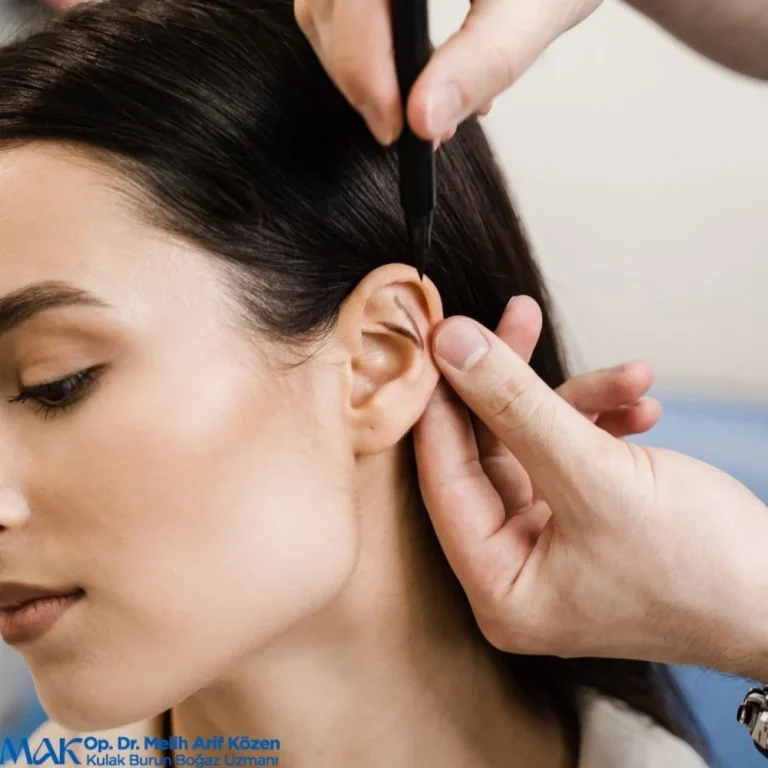
What Is Prominent Ear Correction?
Practising in İzmir, Ear, Nose & Throat specialist Op. Dr. Melih Arif Közen treats his patients using modern prominent ear correction (otoplasty) techniques that reposition the ears at a natural angle, in proportion to the head. Otoplasty is a surgical procedure in which ears that protrude forward (prominent ears) or have an irregular shape are given a balanced appearance in harmony with the facial features.
Although prominent ears do not pose a health problem, they can affect a person’s self-confidence and social life; because they can become a target of teasing, especially in childhood, the psychological impact is significant. The aim of otoplasty is not a sharp, “operated-on” look, but rather a symmetrical, lasting appearance that preserves the natural folds of the ear. The procedure both addresses aesthetic concerns and corrects asymmetry between the two ears.
Because ear development is largely complete by the age of 5–6, otoplasty can be safely performed from school age onward. Performing it at an early age helps prevent the negative social effects a child may experience during their school years.
What Is Prominent Ear Correction?
Prominent ear correction (otoplasty) is a surgical procedure used to correct conditions such as ears that protrude too far from the head, underdeveloped folds, or an asymmetric appearance. The aim is to bring the ears closer to the head and reshape their natural folds to achieve a balanced appearance in harmony with the face.
Correcting the Ear Angle
By reducing the excessive angle between the ear and the head, the ears are brought closer to the head; the prominent appearance seen from the front disappears.
Creating the Fold
Underdeveloped ear folds (antihelix) are reshaped, giving the ear a natural form.
Achieving Symmetry
Differences in size and angle between the two ears are corrected to achieve a balanced, symmetrical appearance.
Lasting Result
Because the cartilage is fixed in its new shape, the result is permanent and does not revert over time.
Otoplasty can be performed not only for prominent ears but also for ear fold abnormalities, asymmetry, and deformities following trauma. The procedure can be performed on one ear or on both ears together.
In Which Cases Is Prominent Ear Correction Performed?
Otoplasty may be preferred for both congenital differences in ear shape and abnormalities that develop later. The following situations are the main reasons for which prominent ear correction is most frequently evaluated.
Pronounced Prominent Appearance
Ears that protrude too far from the head and stand out noticeably when viewed from the front are the most common reason.
Fold and Asymmetry Problems
Underdeveloped ear folds, or a noticeable difference in size and angle between the two ears, require correction.
Trauma and Deformities
Deformities resulting from a blow or accident, as well as congenital structural deformities, can be reshaped.
For otoplasty, it is sufficient for ear development to be complete; the procedure can therefore be performed on both school-age children and adults. There is no upper age limit; it can be performed at any age in those whose health is suitable.
Which Methods Are Used in Prominent Ear Correction?
The technique used in prominent ear correction is determined according to the structure of the ear, the type of problem, and the patient’s age. The main approaches used are as follows.
Classic Otoplasty
The cartilage is reached through an incision made behind the ear; the folds are created and the ear is brought closer to the head and fixed with sutures. Because the scar remains behind the ear, it is not visible.
Suture (Thread) Technique
With minimal intervention to the cartilage, the shape of the ear is corrected using special suture techniques. In patients with suitable anatomy, it provides faster recovery with less tissue disruption.
Cartilage Reshaping
The method in which the cartilage is thinned and reshaped is preferred to achieve a natural form in ears with an indistinct fold.
Which method will be used is determined after the examination. While the procedure can usually be performed under local anesthesia in adults, general anesthesia may be preferred in young children for comfort.
Preparation Before Prominent Ear Correction
Although otoplasty is a relatively short and comfortable procedure, the correct evaluation carried out beforehand directly affects the outcome and safety. At this stage, the ear structure is examined and the appropriate technique is planned for the patient.
Examination and Planning
The ear structure, folds, and angle are assessed. The difference between the two ears is measured, and a realistic result is planned using the technique appropriate for the patient.
General Health Check
Necessary tests are performed, especially in children for whom general anesthesia is planned. Medications used are reviewed; if there are any blood thinners, the physician is informed.
Before the procedure, it is important that the hair is clean and there is no infection in the ear area. In pediatric patients, explaining in advance how the procedure will proceed helps the child feel more at ease.
How Is Prominent Ear Correction Surgery Performed?
Depending on the structure of the ear and the technique used, otoplasty is a relatively comfortable procedure that usually takes 1–2 hours. While local anesthesia is mostly sufficient in adults, general anesthesia may be preferred in children. The process proceeds in defined stages.
Anesthesia and Preparation
The anesthesia method appropriate for the patient is applied. The ear and the surrounding area are sterilized; the incision site is determined according to the planned technique.
Reshaping
The cartilage reached from behind the ear is reshaped; the folds are created and the ear is brought closer to the head and fixed with special sutures.
Closure and Fixation
The incision is sutured and a protective bandage is applied so that the ear maintains its new shape. The patient is usually discharged the same day.
Let’s Determine the Right Method for Your Ears Together
To learn the otoplasty approach most suitable for you or your child, you can consult Op. Dr. Melih Arif Közen.
Recovery Process After Prominent Ear Correction
Recovery after otoplasty is usually quick and comfortable. There may be mild swelling and tenderness in the first few days; this subsides within a few days. Following the protective bandage and the physician’s recommendations is important for maintaining the result.
The First Days
The protective bandage remains in place for a few days. Mild pain and tenderness may occur; this is easily controlled with the painkillers provided.
The Following Weeks
Most patients return to their daily lives within 1 week. A headband may be recommended to protect the ear at night; full recovery is completed within a few weeks.
Contact your physician without delay in the following situations:
- Increasingly severe pain
- High fever
- Marked redness, discharge, or swelling in the ear area
- Opening of the suture site or excessive bleeding
During the first weeks, it is necessary to avoid any blow to the ear and lying on it. Following your physician’s recommendations on when to return to activities such as sports and swimming is important for the durability of the result.
Related Treatments
Frequently Asked Questions
What is the ideal age for prominent ear surgery?
Because ear development is largely complete by the age of 5–6, otoplasty can be safely performed from school age onward. Performing it at an early age prevents the negative social effects a child may experience during their school years. There is no upper age limit; it can also be performed on any adult in good health.
Will the surgical scar be visible?
Because the incision is usually made behind the ear, the scar remains hidden behind the ear fold and is not noticeable from the outside. With suture techniques, the intervention is minimal, so the scar is even fainter.
Is the procedure painful?
Because the surgery is performed under anesthesia, no pain is felt during the procedure. Afterward, there may be mild tenderness and a sensation of pressure; this is easily controlled with the painkillers provided.
Is the result permanent, or do the ears protrude again?
In otoplasty performed with the correct technique, the result is permanent because the cartilage is fixed in its new shape. Following the physician’s recommendations and protecting the ear during the first weeks supports the longevity of the result.
When can I return to my daily life after surgery?
Most patients return to school or work within 1 week. For activities such as heavy sports and swimming, waiting a few weeks is recommended in order to protect the ear from any blow.